What Happens If You Fail a DOT Drug Test? Return-to-Work Process Explained
As a certified DOT Medical Examiner practicing right here in Charlotte, North Carolina, I see drivers walk into my clinic with panic in their eyes after receiving news of a failed DOT drug test. Whether it was a positive result for THC, an unexpected prescription flag, or a test refusal, the feeling is usually the same: Is my career over?
The short answer is no, your career isn’t over. But your ability to perform safety-sensitive duties—like driving a commercial motor vehicle (CMV)—is paused immediately.
Under Federal Motor Carrier Safety Administration (FMCSA) guidelines, a violation triggers a mandatory, step-by-step process before you can legally step foot inside a truck cab again. Here is what actually happens when you fail a DOT drug test in North Carolina, and how you can navigate the path back to work.
Step 1: Immediate Removal from Safety-Sensitive Duties
The moment a Medical Review Officer (MRO) verifies a positive drug test result (or a test refusal), federal law under 49 CFR Part 40 requires your employer to remove you from performing safety-sensitive duties immediately.
If you are an independent owner-operator, your consortium/third-party administrator (C/TPA) will issue the notice. The violation is also reported to the FMCSA Drug and Alcohol Clearinghouse, a central database accessible to commercial motor carriers nationwide.
At this point, you cannot drive, operate heavy equipment, or handle any regulated tasks. Trying to bypass this rule or switch employers without resolving the issue will only jeopardize your Commercial Driver’s License (CDL) permanently.
Step 2: The Core of Recovery — The Substance Abuse Professional (SAP) Evaluation
This is where many drivers get confused. You cannot simply wait a few months, take a new drug test, and go back to work. Federal regulations require you to go through the CDL Return-to-Duty (RTD) process managed by a DOT-qualified Substance Abuse Professional (SAP).
I always explain to my patients that while I evaluate your overall physical clearance during a medical exam, the SAP is the designated “gatekeeper” for substance violations. They evaluate what happened and determine what education or treatment you need.
In my detailed guide on how the CDL SAP program works for return-to-duty in Charlotte, NC, I break down the exact 6-step roadmap you will follow with your SAP. In short, the SAP will:
-
-
Conduct an initial clinical evaluation.
-
Recommend a prescribed education or treatment program (ranging from short courses to structured outpatient counseling).
-
Conduct a follow-up evaluation to confirm you completed all requirements
-
Step 3: Taking the Directly Observed Return-to-Duty (RTD) Drug Test
Once your SAP issues a official Notice of Compliance stating you have fulfilled your education or treatment plan, you are eligible for a Return-to-Duty (RTD) drug test.
Here is what you need to know about the RTD drug screen:
-
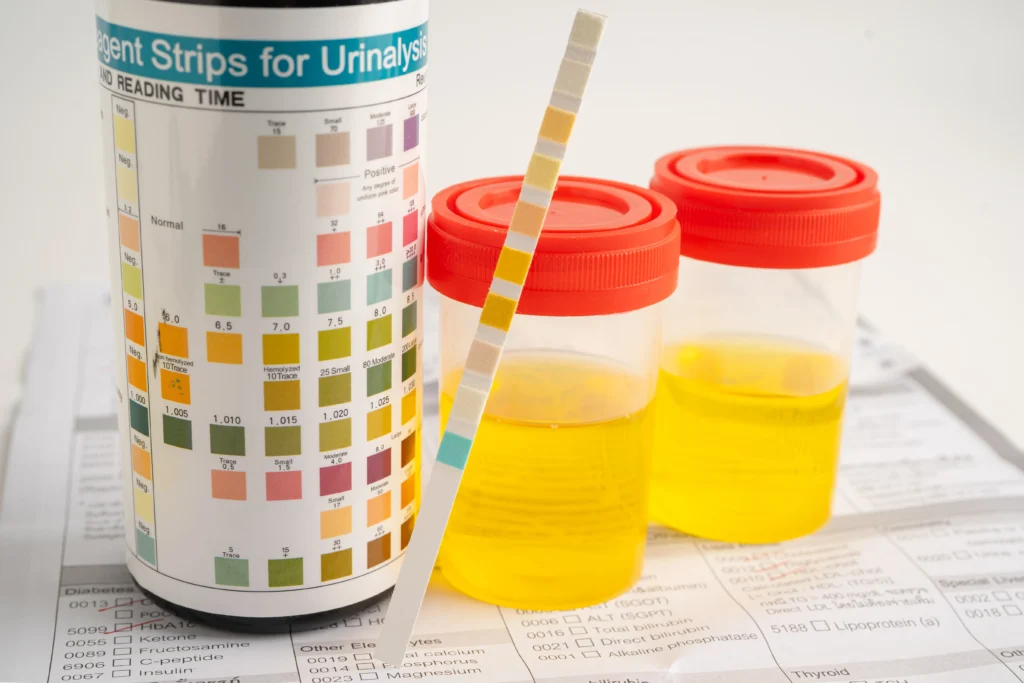
Direct Observation: Federal rules require all DOT Return-to-Duty urine collections to be directly observed by a collection specialist.
-
Must Be Negative: You must test completely negative for all standard 5-panel substances before an employer can clear you to drive.
-
Employer-Driven: Your employer (or new employer) orders the RTD test after receiving the SAP clearance paperwork.
Step 4: The Unannounced Follow-Up Testing Plan
Passing your RTD test allows you to get back behind the wheel, but the process does not end on day one back at work.
Your SAP will establish a mandatory Follow-Up Testing Plan. By law, this involves a minimum of 6 unannounced directly-observed drug tests over the first 12 months following your return to safety-sensitive duties. Depending on the SAP’s recommendations, follow-up testing can continue for up to 5 years.
How We Help Drivers in Charlotte, NC
When you are ready to complete your required workplace drug testing, routine physicals, or recertifications, having a trusted partner makes all the difference. At Carolina MedWorks, located right on Lamar Ave in Charlotte, I work directly with drivers and local fleets to ensure fast, compliant, and dignified care.
Whether you need pre-employment screenings, regular DOT physicals, or post-SAP return-to-work coordination, we keep the administrative friction to a minimum so you can focus on your career.
FAQs
-
Can I just apply at a different trucking company if I fail a drug test?
No. All DOT drug and alcohol violations are logged in the FMCSA Clearinghouse. Any prospective employer is required by law to run a pre-employment query on your record. They cannot legally hire you for a safety-sensitive position until the Clearinghouse shows your Return-to-Duty process is complete.
-
Does a refusal to test count as a failed test?
Yes. Under DOT rules, refusing to submit to a required drug screen—whether pre-employment, random, post-accident, or reasonable suspicion—carries the exact same penalties as a positive test result. You will still be required to complete the full SAP process.
-
Who pays for the SAP program and Return-to-Duty test?
DOT regulations do not dictate who pays for the SAP evaluation or subsequent testing. Some employers cover the costs, but in most cases, the driver is responsible for paying the SAP fees and testing costs.
-
Where can I get compliant DOT drug testing in Charlotte, NC?
At Carolina MedWorks in Charlotte, NC, we provide fast, confidential DOT and non-DOT drug testing, along with same-day DOT physical exams. You can schedule online or walk in during our regular business hours.